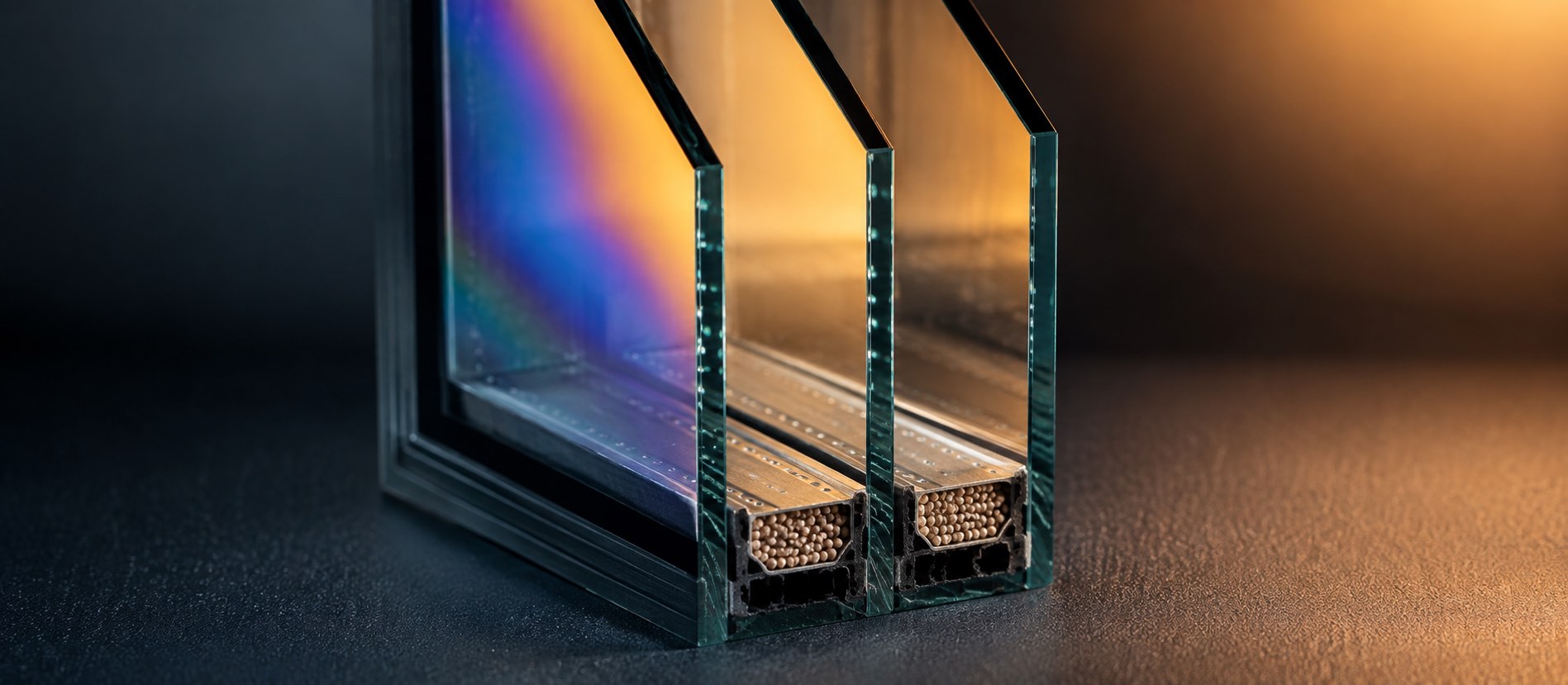
Number of panes
Adding a third pane adds a second insulating cavity, and the improvement is real but not linear. The step from single to double glazing is transformative; the step from double to triple is meaningful but considerably smaller, and it arrives with weight, cost, and a thicker sash.
Triple glazing earns its keep most clearly in three situations: colder zones where the heating season is long, houses targeting an airtightness or energy target where the windows would otherwise be the weak element, and rooms where people sit close to large areas of glass — because the interior surface of a triple unit stays warmer, and comfort near glazing is largely a radiant-temperature question rather than a heat-loss one.
Low-emissivity coatings
A low-E coating is a microscopically thin metallic layer that reflects long-wave infrared while staying largely transparent to visible light. It is the single highest-leverage component in modern glazing, and it is invisible in normal use.
| Hard-coat (pyrolytic) | Soft-coat (sputtered) | |
|---|---|---|
| Applied | During float-glass manufacture, while hot | In a vacuum chamber, after |
| Durability | Robust; can face a cavity or, in some products, be exposed | Fragile; must be sealed inside the unit |
| Emissivity | Higher — less effective | Lower — more effective |
| Solar gain | Tends to pass more solar heat | Available tuned across a wide range |
| Typical use | Where some passive gain is wanted | Most contemporary high-performance units |
The practically important point is that "low-E" on a quote is not one thing. Soft-coat products are made in families tuned to different solar-gain targets, which is what makes per-elevation specification possible at all. If a quote says only "low-E," it has not yet told you what the window will do on a south wall in February.
Gas fill
The cavity between panes is normally filled with an inert gas that conducts heat less readily than air. Argon is the default: inexpensive, widely available, and close to optimal for the cavity widths used in typical double glazing. Krypton conducts less still and performs better in narrow cavities, which is precisely why it appears in triple-glazed units — three panes in a sash of manageable thickness means narrower gaps, and narrow gaps are where argon starts to lose its advantage. Krypton is substantially more expensive.
Two honest caveats. Fill rates are not 100% by design, and sealed units lose some fill over their service life; a unit that depends heavily on its gas fill degrades more visibly than one that does not. And a gas fill cannot rescue a poor coating — the coating does more work.
Spacers and the edge of glass
The spacer holds the panes apart and seals the cavity. Traditional aluminium spacers do this well and conduct heat enthusiastically, which creates a cold band around the perimeter of the glazing — the reason condensation appears at the edges of a window and not in the middle. Warm-edge spacers substitute lower-conductivity materials and measurably raise the temperature of that band.
This is a small component with a visible consequence. Edge-of-glass condensation is one of the most common complaints about otherwise good windows, and it is generally an interior humidity problem meeting a cold surface. Raising the surface temperature is one of the two available levers; the other is managing indoor humidity, which is a ventilation question rather than a window question.
Where the money goes. If you are optimising a budget across a whole house: coating first, then spacer, then gas fill, then the third pane. That order reverses in the coldest zones, where the third pane moves up. Climate zones covers where that line falls.